For decades, energy has been viewed as a necessary cost of doing business. Today, leading commercial and industrial organizations are looking at energy differently. With federal tax incentives, Illinois renewable energy programs, utility rebates, and advances in energy storage, businesses have a unique opportunity to transform energy from a recurring operating expense into a long-term asset that delivers value for decades. For CEOs, CFOs, business owners, and facility leaders, the question is no longer whether solar and energy storage make financial sense. The question is whether waiting could cost more than acting now.
Every month, businesses pay utility bills that generate no return. Meanwhile, many facilities already have valuable assets sitting unused: rooftops, electrical infrastructure, and available property that can be leveraged to produce energy and reduce operating costs. When combined with solar and energy storage, these assets can generate predictable savings, improve resilience, and help businesses gain greater control over future energy expenses. The challenge is that today’s favorable market conditions may not last forever. Federal incentive programs are evolving. Businesses that act now are often in the best position to maximize incentives and secure the strongest financial outcomes.
Federal & State Incentives Align Offering Tremendous Opportunity to Illinois Businesses
Illinois currently offers one of the most attractive renewable energy investment environments in the country.
Commercial and industrial organizations may be able to take advantage of:
- Federal Clean Electricity Investment Tax Credits
- Domestic Content Bonus Credits
- Energy Community Bonus Credits
- Low-Income Community Bonus Programs
- Illinois Shines Renewable Energy Credit (REC) Revenue
- ComEd Solar Incentives
- ComEd Energy Storage Incentives
- Favorable Property Tax Treatment
When layered together, these programs can significantly reduce project costs while improving long-term return on investment. For many businesses, incentives are changing the economics of energy infrastructure altogether.
The conversation around renewable energy has changed. Today’s business leaders evaluate solar and energy storage the same way they evaluate any major capital investment:
- Return on investment
- Cash flow generation
- Payback period
- Risk reduction
- Asset value creation
- Operational resilience
When properly designed, solar and storage systems do more than reduce utility bills. They generate predictable savings, provide protection against rising energy costs, and create measurable long-term value. Energy becomes a controllable business asset rather than an unpredictable expense.
Illinois Companies Are Already Seeing Results
Across Illinois, businesses are using renewable energy to strengthen both financial performance and operational efficiency. Distribution centers are converting unused rooftop space into revenue-generating assets. Manufacturers are leveraging incentives to offset project costs while reducing long-term energy expenses. Commercial businesses are producing enough renewable energy to meet a substantial portion—or even all—of their annual electrical demand. Organizations are using proven technologies and available incentives to gain a competitive advantage.
The Cost of Waiting Can Be Significant
Many organizations assume there is little downside to delaying evaluation. In reality, waiting can have a cost. Federal Tax Incentives will begin to phase out, eliminating key incentives that lower the upfront costs of your infrastructure and lifetime ROI. For facilities with large electrical loads or long-term ownership plans, these missed opportunities can add up to hundreds of thousands—or even millions—of dollars over the life of the infrastructure. The businesses achieving the strongest returns are often the ones that begin planning before incentives become more restrictive and project demand increases.
The most successful organizations are constantly looking for ways to reduce risk, improve profitability, and strengthen long-term competitiveness. Today’s energy incentive environment offers a rare opportunity to accomplish all three. Solar and energy storage are no longer simply sustainability initiatives. They are strategic infrastructure investments that can generate financial returns, improve resilience, and create long-term enterprise value.
For Chicagoland business leaders, the opportunity is clear:
- Reduce operating costs
- Capture available incentives
- Improve energy resilience
- Create long-term asset value
Most importantly, act while today’s opportunities remain available.
Download Hardt Electric’s Energy Incentive Resource Guide for Illinois Business
Understanding available incentives, utility programs, and project economics is the first step toward making an informed investment decision.
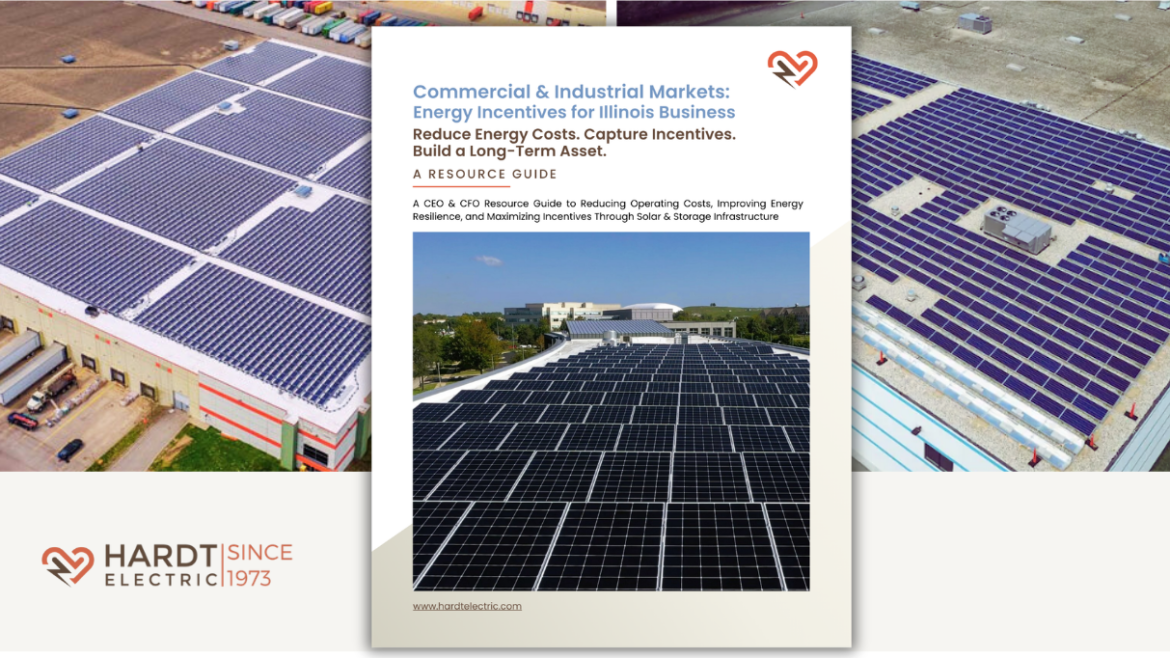
Hardt Electric’s Energy Incentive Resource Guide for Illinois Businesses provides an executive overview of federal tax credits, Illinois incentive programs, utility rebates, energy storage opportunities, and real-world project examples from across Illinois.
Download the guide today to discover how your business can turn energy costs into a long-term strategic asset.
For more than 50 years, Hardt Electric has helped Chicagoland businesses solve complex electrical infrastructure challenges.
Hardt Electric helps clients evaluate opportunities, identify incentives, navigate utility requirements, and design energy solutions that maximize long-term financial performance. Because the best energy projects aren’t simply about installing equipment. They’re about transforming energy from an expense into a strategic business asset.
Now is the time to find out what your facility may qualify for. Contact us to get started: solar@hardtelectric.com